What Businesses Should Know About Commercial AC Unit Installation
September 30 2026by Maximum Climate Control
Warm summers put pressure on every workplace, and a poor cooling decision costs money for years afterward. Business owners searching for local air conditioning companies often find the market crowded, and choosing the right partner for commercial AC unit installation can make the difference between a system that works quietly in the background and one that causes problems from day one.
Maximum Climate Control has spent nearly three decades designing, installing, and maintaining air conditioning across Hampshire, the South Coast, Sussex, Kent, Surrey, and London. That experience has taught us what separates a dependable air-conditioning installation service from one that simply installs equipment and moves on.
Why Businesses Prefer Local Air Conditioning Companies
Offices, restaurants, hotels, schools, and server rooms all place different demands on a cooling system, so a generic solution rarely suits every space. Local air conditioning companies bring an understanding of regional building types, planning requirements, and the practical challenges of installing equipment in occupied commercial premises.
Proximity matters for ongoing support too. A local team responds faster to breakdowns, understands regional weather patterns, and builds a relationship with your business over time rather than treating installation as a one-off job.
Signs of a Reliable Air Conditioning Installation Service
Not every installer approaches a project the same way, and the differences show up long after the system goes live.
A proper air conditioning installation service starts with a survey rather than a quote pulled from a brochure. Engineers should assess occupancy, glazing, equipment heat loads, and layout before recommending a system, because guesswork at this stage can lead to units that struggle to cope or waste energy by running harder than necessary.
Accreditation is another critical factor. F-Gas qualifications, CHAS certification, and BESA membership all signal an installer that takes safety and compliance seriously. Businesses should ask to see these credentials before signing off on any commercial AC unit installation, rather than assuming every quote comes from an equally qualified team.
Commercial AC Unit Installation Needs Proper Planning
Fitting a large ducted system into an office block differs enormously from installing a wall-mounted unit in a small shop, yet both require the same attention to detail at the planning stage.
Load Calculations and Design Come First
Correct sizing depends on load calculations that account for occupancy, equipment, glazing, and building orientation. Undersized systems run constantly without ever reaching the set temperature, while oversized ones cycle on and off too quickly, wasting energy and wearing components out faster than they should.
Duct design and airflow balancing follow from those calculations. Zoning allows different areas (a boardroom, an open-plan floor, or a server room) to run at different temperatures rather than forcing a single setting across the whole building.
Choosing Equipment That Suits the Building
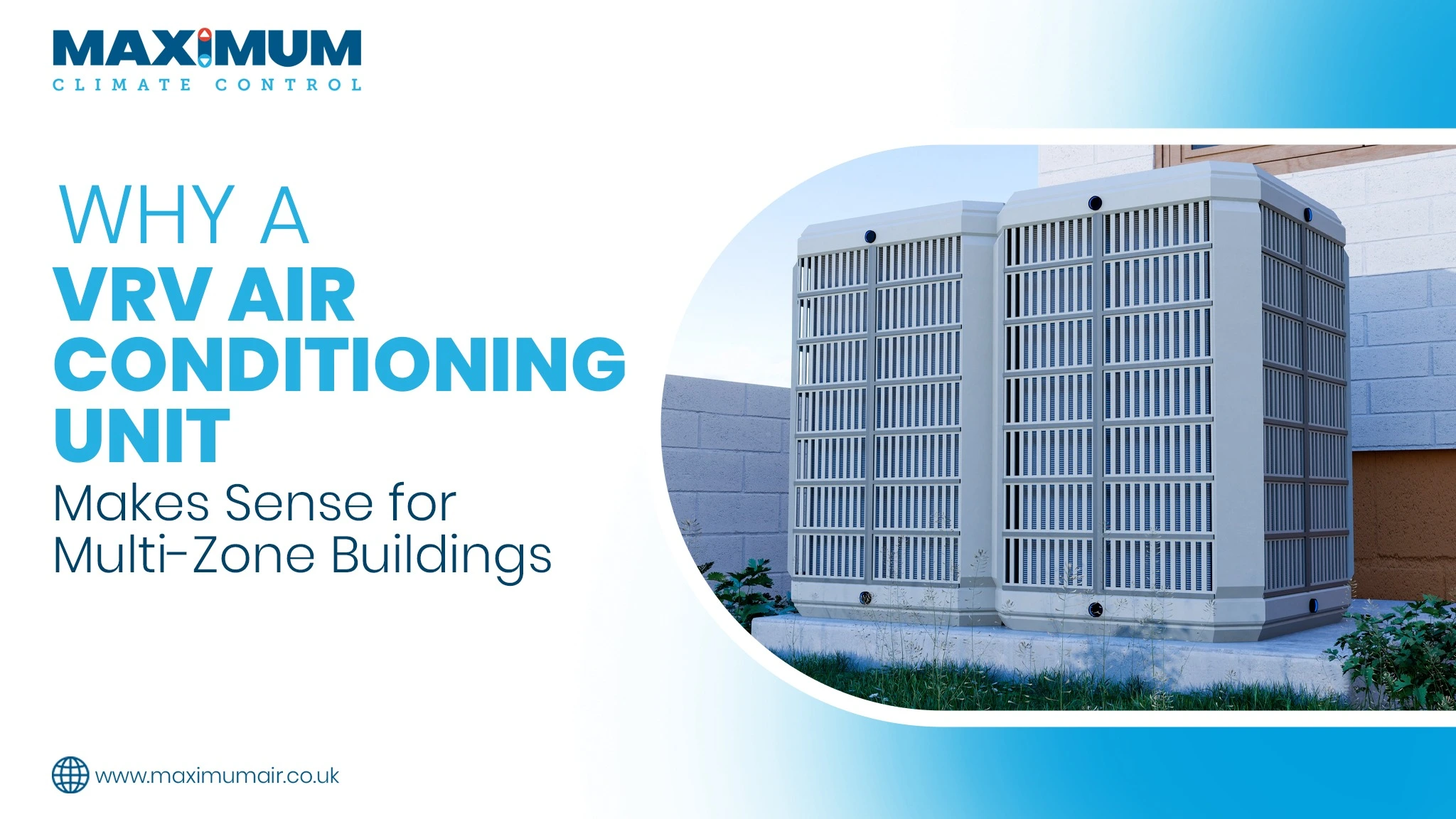
Daikin, Toshiba, Panasonic, and Mitsubishi all produce reliable commercial systems, though the right choice depends on the building rather than brand preference alone. VRV and VRF systems suit multi-zone buildings well, since they let several indoor units run from shared outdoor equipment while offering independent room-by-room control.
Smaller premises often benefit from simpler wall-mounted or ceiling cassette units, which cost less to install and maintain while still delivering reliable comfort. A good air conditioning installation service recommends equipment that fits the actual space rather than pushing the most expensive option available.
Not sure which system suits your building? Book a free survey with our engineers and get a recommendation built around your space, not a standard package.
Compliance Matters as Much as Comfort
Commercial systems exceeding certain refrigerant thresholds are required by law to undergo regular F-Gas leak checks, and TM44 inspections apply to air-conditioning systems above 12kW in most commercial buildings. Failing to meet these obligations creates legal risk as well as the practical problems of a poorly maintained system.
A reputable air conditioning installation service explains these requirements upfront rather than leaving business owners to find out later. Planned preventive maintenance contracts keep systems compliant and running efficiently, catching minor issues before they turn into expensive breakdowns.
Working Around a Live Business
Installation rarely takes place in an empty building. Offices, restaurants, and retail units all need to continue operating while engineers work, and scheduling around business hours helps protect revenue during the project.
Experienced installers plan work overnight, over weekends, or during quieter trading periods wherever possible. Keeping disruption to a minimum during commercial AC unit installation matters just as much as the quality of the finished system, particularly for businesses that cannot afford to close their doors.
Looking Beyond the Installation Date
A commercial AC unit installation is the start of a much longer relationship, not a one-off transaction. Servicing twice a year keeps a system running at its rated efficiency and catches worn parts, refrigerant leaks, and blocked filters before they lead to a full breakdown during a heatwave.
Energy costs sit high on most business agendas, and a correctly installed, well-maintained system uses noticeably less power than one left to run without attention. Filters clogged with dust force a unit to work harder for the same result, while refrigerant leaks reduce cooling capacity long before anyone notices a fault warning.
Choosing an air conditioning installation service that offers ongoing maintenance contracts, rather than disappearing after handover, gives business owners a single point of contact for servicing, compliance checks, and repairs. Continuity matters when a fault needs to be diagnosed quickly, since an engineer already familiar with your system resolves problems faster than one starting from scratch.
Why Choose Maximum Climate Control
With 29 years of experience across the South of England, our engineers have a depth of knowledge that shows in every project we design and install. We work with trusted brands, including Daikin and Toshiba, hold F-Gas and CHAS accreditation, and plan every commercial AC unit installation around how your business actually operates.
Clients including Holiday Inn, Ted Baker, the BBC, Greggs, and Hilton have trusted us with their cooling and ventilation projects, and we bring the same care to businesses of every size.
Picking the right air conditioning installation service protects your investment for years to come, not just for the first summer after installation.
Ready to talk through your options? Speak to one of our experts on 02392 261005 or request a quote today.
Frequently Asked Questions
- How long does a commercial AC unit installation take?
A single wall-mounted or ceiling cassette unit often takes a day or two, while a full ducted or VRV/VRF system across multiple zones can run to several weeks. The final timeline will depend on building access, existing infrastructure, and the extent of work to be carried out outside normal trading hours.
- Do I need planning permission for a commercial air conditioning installation?
Most installations are permitted development, but listed buildings, conservation areas, and some external unit placements sometimes require consent. A good air conditioning installation service checks this during the survey stage rather than leaving you to find out partway through the project.
- What’s the difference between a VRV/VRF system and standard split units?
VRV/VRF systems use a single outdoor unit to power several indoor units, providing separate temperature control for each zone while sharing the same infrastructure. Standard split systems pair one indoor unit with one outdoor unit, which suits smaller premises better than large multi-zone buildings.
- How much does commercial AC unit installation typically cost?
Costs vary widely between a single split unit and a full VRV installation across an office block, and depend heavily on system type, building size, and the complexity of ductwork or pipework involved. A site survey gives an accurate quote rather than a rough estimate based on square footage alone.
Share this article
If you’re looking for advice or a quote for a new HVAC system or maintenance, get in touch with our expert!
Speak to an expert Explore Our Product RangeFor further reading
September 30 2026By Maximum Climate Control
What Does Commercial Air Conditioning Service Involve?
When most people think of commercial air conditioning, they picture a wall-mounted unit, a remote control, and a simple annual service. In a small office or a single-room retail space, that picture is not far off. In most commercial buildings, though, […]

September 07 2026By Maximum Climate Control
Why a VRV Air Conditioning Unit Makes Sense for Multi-Zone Buildings
Most air conditioning problems in larger buildings are not down to the equipment. They are often due to the mismatch between what the building needs and what a single-zone system was designed to do. One thermostat cannot serve a boardroom […]